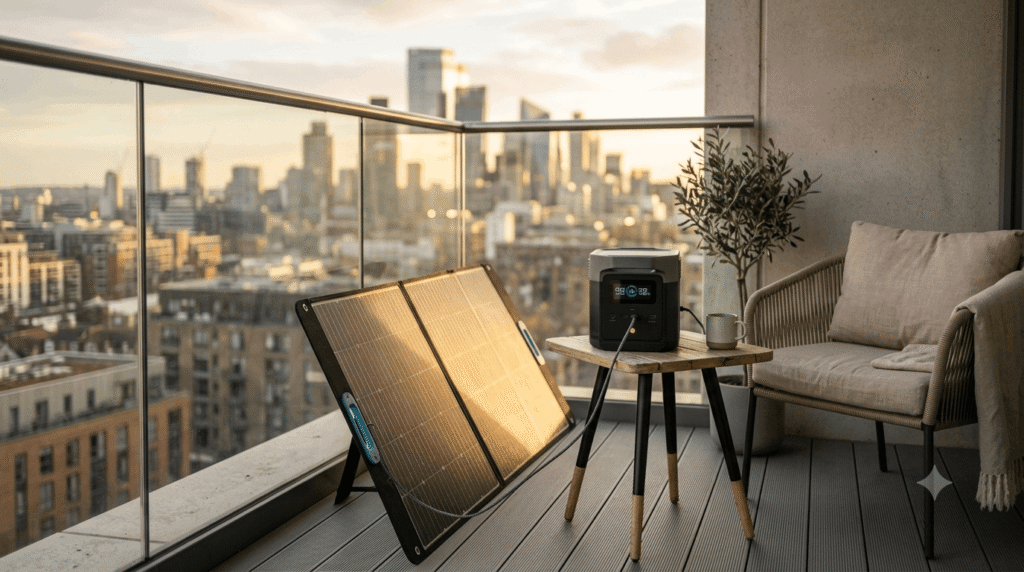
Let's be honest for a second.
Electricity bills keep going up every single year. And if you're renting, you basically watch it happen and just... pay.
You can't slap solar panels on a roof you don't own. Your landlord isn't going to say yes to drilling holes or running wires through the walls. So what's left? Nothing, right?
Wrong.
Best Solar Generator for Apartments in 2026 USA & UK Buyer’s Guide That's exactly where a solar generator comes in. No permits. No installation crew. No awkward conversation with your landlord about "can I please install solar panels."
You just plug it in, charge it up (with the sun or a wall outlet), and you've got backup power sitting in your closet, ready whenever you need it. Power cut? You're covered. Camping trip? Grab and go. Bill trying to sneak higher every month? You've got a way to fight back a little.
This isn't some far-off dream tech either. Thousands of renters and apartment owners across the US and UK are already doing this. And in 2026, the options are better (and cheaper) than ever.
Here's what we're going to walk through together:
How solar generators actually work (in plain English, promise)Our top tested picks — the ones actually worth your money
How to set one up on a balcony, even a tiny one
The legal stuff you need to know if you're in the USA or UK (yes, it's different in both places)By the end, you'll know exactly which model fits your space, your budget, and your daily power needs.
One quick thing before we dive in — a lot of people ask us if solar is even still worth it now that the tax credit situation has changed. Not sure if solar is even worth it in 2026? Read our full breakdown → Is Solar Still Worth It in 2026 Without the Tax Credit?
Okay, quick myth to bust first.
When people hear "generator," they think of those loud, smelly gas ones. The kind you have to keep outside because of fumes. The kind your neighbors can hear from three floors down.
Solar generators are nothing like that.
They run under 45 dB. That's quieter than your fridge humming in the kitchen.
Zero carbon monoxide. Which means zero risk of running it indoors.
No fuel, no fumes, no smell. Just a battery that charges up and gives power back when you need it.
So yes, you can actually keep one in your living room or bedroom closet. Try that with a gas generator and you'd probably get a visit from the fire department.
Here's the whole process, broken down simply:
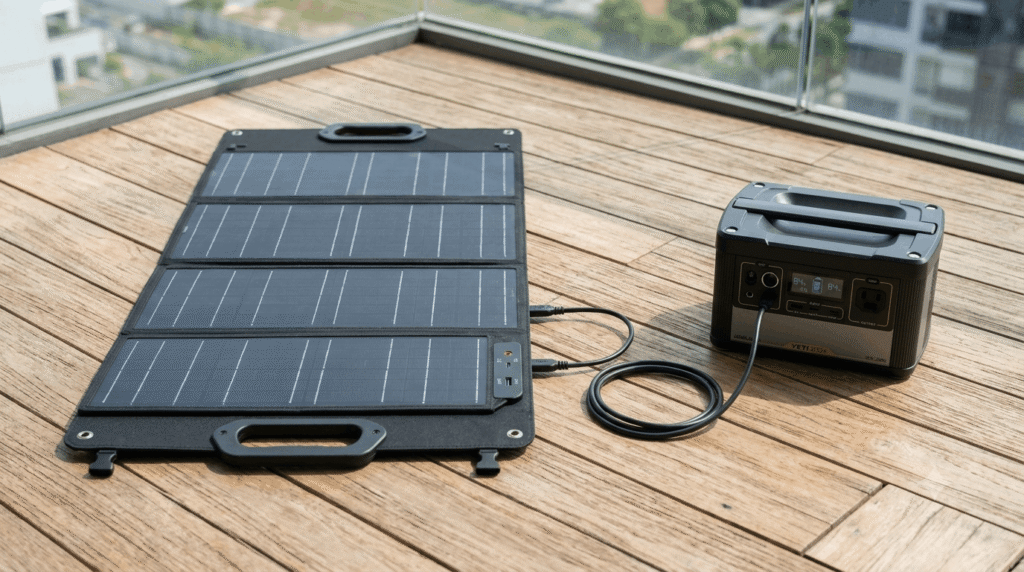
You set up a foldable solar panel on your window sill, balcony railing, or even just prop it against a sunny wall.
The panel soaks up sunlight and sends that energy into the generator's battery (usually LiFePO4, which is the safe, long-lasting type).
The battery stores that power.
You plug your devices straight into the generator, just like a wall socket.
That's it. No wiring, no electrician, no landlord drama.
Think of it like a giant power bank for your whole apartment. Charge it during the day when the sun's out, use it whenever you need it after that — day or night, sunny or not.
Even a small balcony with a few hours of direct sun is usually enough to get a decent charge going.
Not everyone needs the same size generator. It really depends on what you're trying to power. Here's how it breaks down:
Tier 1 ($200–$400) — The Basics
Perfect if you just want to keep the essentials alive.
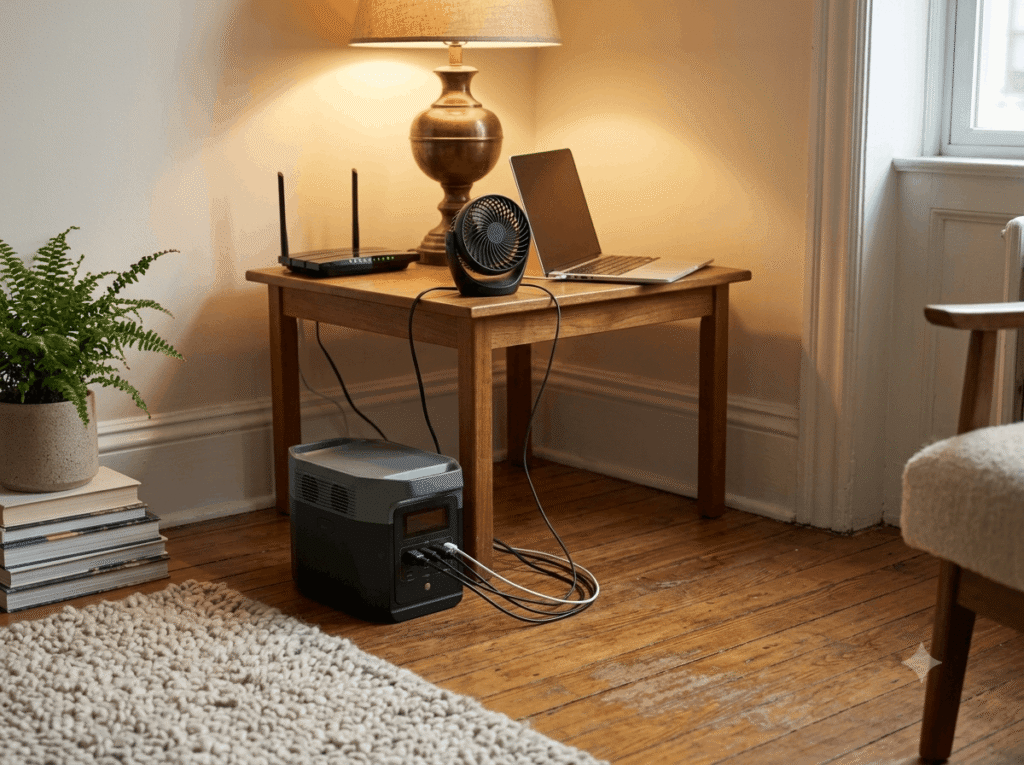
Wi-Fi router
LED lights
Phone and laptop charging
A small fan
This tier is great for students, small studios, or anyone who just wants peace of mind without spending big.
Tier 2 ($400–$800) — The Comfort Zone
This is the sweet spot for most apartment dwellers.
Mini fridge
TV
CPAP machine
Basic home office setup (monitor, laptop, router)
If you work from home or have medical equipment that needs to stay on, this tier is where you want to be.
Tier 3 ($800–$1,500+) — Full Backup Mode
This is for people who want real peace of mind during a blackout.
Full-size fridge
Portable AC unit
Microwave
Basically your whole apartment running like normal, even during an outage
If you've ever sat through a power cut sweating in the dark wondering if your fridge food is going bad — this tier is the answer.
Let's talk numbers for a second. Because numbers don't lie.
The average electricity rate right now is 18.83 cents per kWh (August 2026). Four years ago, in 2022, it was just 15.04 cents. That's a 25% jump. In four years.
And it's not slowing down either. Rates have climbed every single year since 2022, and experts are predicting another 3-5% rise through 2027.
Summer makes it worse. Way worse.
If you're running AC through July and August, your bill can spike hard. Cooling is usually the single biggest chunk of a summer electricity bill in an apartment. So if you're already stressed about your bill in spring, brace yourself for summer.
Ofgem just bumped the energy price cap up by 13%, effective from 1 July 2026. The typical household is now looking at around £1,663 a year for a dual-fuel bill.
Break that down further, and you're paying about 26.11 pence per kWh for electricity, plus a daily standing charge of 57.19 pence — just for staying connected, even if you use zero power that day.
So whether you're in Texas or in Manchester, the story's the same: bills are going up, and there's no sign of them coming back down anytime soon.
Here's the part renters really love.
A solar generator isn't attached to your apartment. It's not bolted to a roof. It's not wired into anything.
Lease ends? Unplug it, pack it, take it with you.
Moving to a new city? It moves with you, no questions asked.
Zero property modification means zero risk of losing your deposit.
No capital loss either — unlike rooftop solar, which stays behind when you leave.
Basically, it's the one energy investment that's 100% yours, no matter where you live next. Curious about other renter solar options beyond generators? → Best Renter-Friendly Solar Options & Portable Kits in 2026
Let's be real with you here. No sugarcoating.
LiFePO4 batteries (the kind used in every generator we recommend) are built to last. We're talking 3,000 to 6,000 charge cycles. In everyday terms, that's roughly 10 years of daily use before performance starts dropping off.
That's a solid decade of backup power from one purchase.
Now, about payback time — how long before it actually "pays for itself" in savings:
Small kit (Tier 1, budget range): 2-3 years
Mid-range setup (Tier 2): 3-5 years
After that window, you're basically saving money every single month it keeps running. Calculate your exact payback period → Free Solar ROI Calculator
Before you buy anything, figure out your space size. Simple as that.
Studio or 1-bedroom apartment: Look at 300Wh to 768Wh. That's enough for lights, phone, laptop, router, small fan.
2-3 bedroom setup: You'll want 1,000Wh or more. More people, more devices, more power needed.
Now here's something a lot of people mix up — continuous watts and surge watts. They're not the same thing.
Continuous watts is what the generator can output steadily, hour after hour. Surge watts is the short burst it can handle for a second or two, usually when something with a compressor kicks on.
Think about your mini fridge. When it starts up, the compressor needs a quick jolt of extra power — way more than it needs to just keep running. If your generator can't handle that jolt, the fridge won't even turn on, even if the "continuous" number looked fine on paper.
So always check both numbers before buying. Don't just look at one and assume you're covered.
Small balcony? No problem. But a few tricks make a real difference.
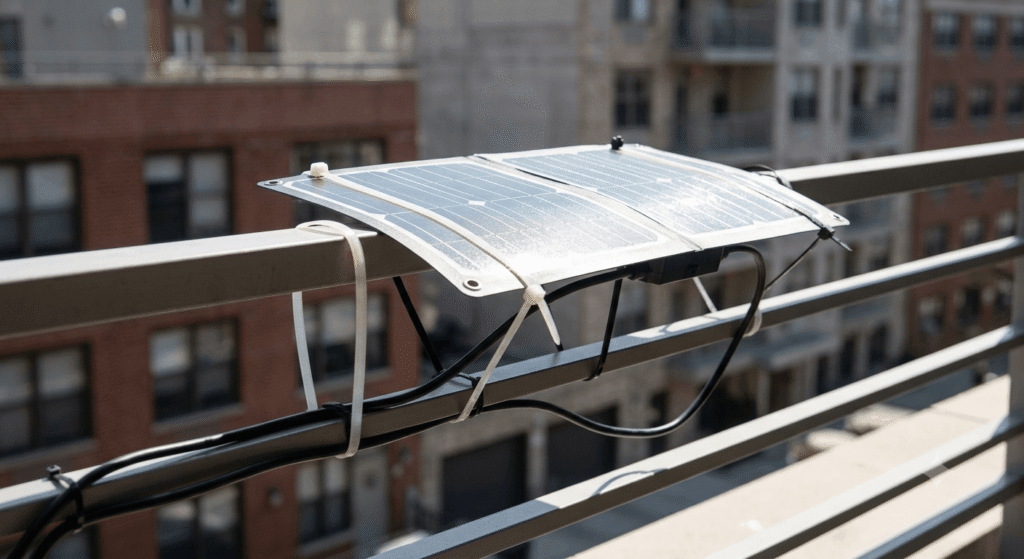
Bifacial panels can grab 15-25% extra power. How? They catch light bouncing off your balcony floor or glass railing, not just direct sunlight from above.
Charging through a window sounds convenient, but here's the catch — window glass blocks 30-50% of the UV and IR rays your panel actually needs to charge efficiently.
Bottom line: always charge outside if you can. Balcony, window ledge, even propped against an open door. Indoor charging through glass will always underperform.
This one matters more than people realize, especially in an apartment where you're sharing walls with neighbors.
LiFePO4 batteries (the type in every generator worth buying) are built with thermal runaway prevention. That basically means they're designed to not overheat and catch fire, even under stress.
Older NMC batteries don't have the same level of protection. They're more sensitive to heat and carry higher fire risk.
This is exactly why LiFePO4 has become the standard for anything you plan to store or charge indoors.
On the paperwork side, most renters' insurance and HOA rules classify these generators as non-hazardous portable electronics — similar to a laptop or a power bank, just bigger. Still, it's smart to double check with your specific insurance provider before you buy, just so there's no surprise later.
Buying from the right region matters more than people think. Plug in the wrong version, and you're stuck.
Runs on 120V / 60Hz
Uses standard NEMA outlets (the same 3-prong plug your other appliances use)
Look for UL 2743 certification — this is the actual safety standard built specifically for portable power packs with AC output
Runs on 230V / 50Hz
Uses Type G, 3-pin plugs
Should be BS 1363 compliant — this is the UK's standard for plug and socket safety
One more feature worth checking, no matter which country you're in — pass-through charging with UPS function. This means if the power suddenly cuts out, the generator switches over in under 20 milliseconds. That's fast enough that your laptop or router won't even blink. Genuinely useful if you've got sensitive electronics or medical equipment running.
Okay, this is the part you've been waiting for. Let's get into it.
We tested, compared, and dug through specs so you don't have to. Here's exactly which one fits your apartment, your budget, and your daily needs.
1. EcoFlow DELTA 3 —  Best Overall for Most Apartments
Specs: EcoFlow DELTA 3 — Best Overall for Most ApartmentsSpecs: 1,024Wh | 1,800W | LiFePO4 | Full charge in 56 min which honestly feels almost too fast the first time you see it happen.
It's compact enough to tuck into a corner, and quiet enough that you won't even notice it running.
Best For: 1-2 bedroom apartments, running actual appliances, remote work setups
Pros:
Fast charging, one of the quickest in this list
Handles bigger surge loads (mini fridge, microwave, etc.)Solid all-around performer, good for most situations
Cons:
Pricier than the budget picks
A bit heavy to carry around daily (27 lbs)
Check Price on Amazon
Specs: 1,070Wh | 1,500W | LiFePO4
If you've never touched a solar generator before, start here. Genuinely, this is the easiest one to just pick up and use.
At 23 lbs, it's the lightest in its class too. Setup takes minutes, not hours.
Best For: First-time buyers, simple blackout backup, people who just want something that works without a manual
Pros:
Super beginner-friendly, minimal learning curve
Lightweight, easy to move room to room
Reliable for basic blackout situations
Cons:
Output is a bit lower than the DELTA 2Fewer advanced features (no fancy app extras)
Check Price on Amazon
Specs: 768Wh | 1,000W (Power Lift: 2,000W) | LiFePO4
This is the sweet spot if you want good specs without paying premium prices. Best price-to-capacity ratio we found in 2026, hands down.
Best For: Budget-conscious renters, studio apartments
Pros:
Great value for the capacity you get
Power Lift mode gives you extra surge headroom when needed
Compact enough for tight apartment corners
Cons:
Not as fast to charge as the DELTA 2App and interface feel a bit basic compared to premium brands
Check Price on Amazon
Specs: 768Wh | 800W | LiFePO4
Small apartment? This might be your best friend. At just 17.2 lbs, it slides under a desk or sits quietly in a closet without taking up real estate you don't have.
Best For: Studio flats, laptops, monitors, lighting setups
Pros:
Smallest footprint on this list, fits anywhere
Light enough to carry with one hand
Enough power for daily essentials
Cons:
Lower wattage output means it can't handle bigger appliances
Not ideal if you're planning to run a fridge
Check Price on Amazon
Specs: 768Wh | 1,200W (1,600W Surge) | LiFePO4
Work from home? This one's built for you. The cooling fans stay under 30dB, so it won't interrupt your calls or your focus.
Best For: Work-from-home professionals, silent UPS backup during power cuts
Pros:
Extremely quiet, barely noticeable while running
Long battery lifespan, built to last years
Good surge capacity for office equipment
Cons:
On the heavier side (19.8 lbs) for its capacity class
Slightly pricier than similar-capacity competitors
Check Price on Amazon
Specs: 268Wh | 600W | LiFePO4
This is the "just getting started" option. Small, cheap, and genuinely useful for keeping the basics running.
It even has a built-in wireless charging pad on top, so you can drop your phone straight on it.
Best For: Students, router/phone backup, tight dorm-style spaces
Pros:
Very affordable entry point
Compact and desk-friendly (just 10 lbs)Wireless charging pad is a nice bonus touch
Cons:
Small capacity, won't last long with bigger devices
Not suitable for anything beyond light, basic use
Check Price on Amazon
Sometimes you just want to see everything at a glance. No scrolling through six sections, just numbers side by side. So here it is.
Prices are approximate MSRP and fluctuate based on Amazon sales. Click product links for current pricing.
Quick way to use this table — just ask yourself two questions. How big is your space? And what's your budget?
Small studio, tight budget? Bluetti EB3A or River 2 Pro. Bigger apartment, want it all? DELTA 2 is your answer.
Everything in between, and one of the other three will fit right in.
Getting the generator is only half the story. Without the right panel, you're just charging it off a wall socket, and that kind of defeats the whole point.
So let's talk panels.
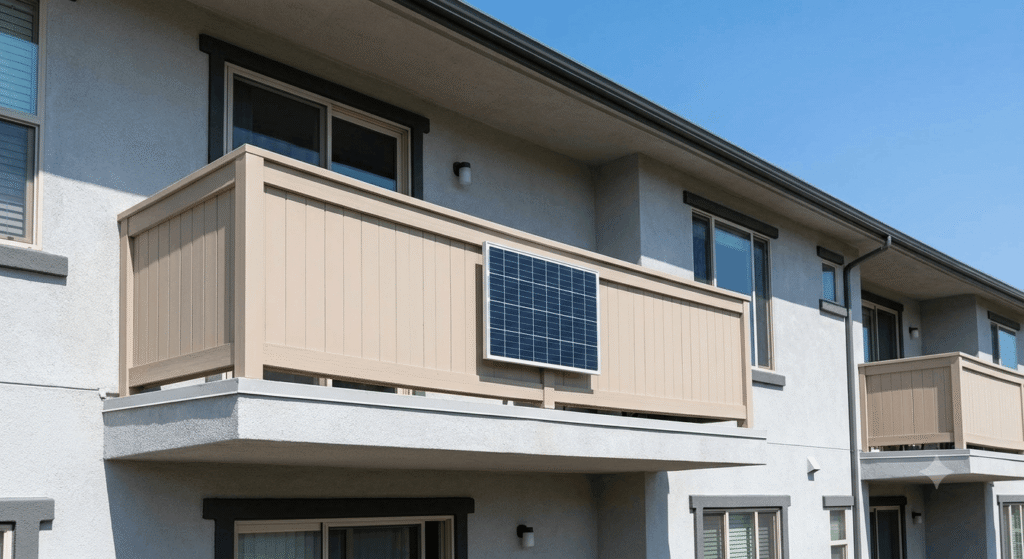
Two main types exist, and honestly, most apartment renters end up going with one over the other pretty quickly once they know the difference.
Fold up small enough to slide under a bed or into a closet
No permanent setup, just unfold and place when you need sun
The clear winner for renters — nothing stays outside when you don't need it
Handle wind and rain a bit better since they're built sturdier
Not as portable, harder to store away
Better if your balcony gets more exposure to weather
If you're short on space (which, let's be honest, most apartments are), foldable wins almost every time.
One thing worth mentioning if you live somewhere high up — wind matters more than people think.
Check the wind-load rating before mounting anything on a high floor
Use zip ties to secure the panel to railings, don't just lean it and hope
A tether cable is a small extra step that saves you from a very bad day if a gust comes through
Here's a neat trick most people don't know about.
You don't need to drill a single hole to get power from your balcony panel into your apartment.
Flat ribbon MC4 cables are thin enough to slide through a closed window or door frame. The window still shuts properly, no gap, no draft, no damage to the seal.
That means:
Zero drilling
Zero seal damage
Your deposit stays 100% safe
Just run the cable through, close the window on top of it, and you're good. It really is that simple.
Not every panel works best with every generator. Here's what actually pairs well:
EcoFlow 160W or 220W Bifacial Panel → pairs with the DELTA 2 and River 2 Pro. The bifacial design even catches reflected light bouncing off your balcony floor, which is a nice bonus in tighter spaces.
Jackery SolarSaga 100W → built specifically for the Explorer 1000 v2, straightforward pairing, no guesswork needed.
Bluetti PV200 → works well with both the AC70 and the EB3A, giving you flexibility if you own or plan to own either one.
Matching the right panel to your generator just makes everything charge faster and work the way it's supposed to.
Want a full guide on renter solar panel options? → Best Renter-Friendly Solar Options & Portable Kits in 2026
Good news first. Really good news, actually.
Portable power stations, the kind we've been talking about this whole guide, are legally treated as consumer electronics. Same category as your laptop or your air fryer.
That means:
No permits required
No electrician needed
No landlord approval necessary
Nothing to register with your utility company
You literally just charge it and use it. That's the whole process.
Now, if you're planning to mount a solar panel on your balcony railing, HOAs sometimes have opinions about what's visible from outside. A few tips to keep things smooth:
Choose a panel that matches your railing color or blends into the background
Angle it so it's not the first thing someone notices walking by
Keep cables tucked and tidy, avoid anything that looks "makeshift"
Most HOAs don't actually ban small foldable panels. They just don't want your balcony looking like a construction site. Keep it neat, and you'll rarely run into pushback.
Here's a combo most people don't think about, and honestly, it's a smart one.
Community solar lets you subscribe to a share of a solar farm near you, without installing a single thing on your property. You get a credit on your electric bill each month, typically 5-15% off, depending on your state and provider.
No hardware. No roof. No panels on your balcony required for this part.
Now stack that with your portable generator:
Community solar chips away at your monthly utility bill
Your portable generator covers backup power and reduces daily grid usage
Together, you're saving on two fronts at once, not just one
It's not a huge dramatic change overnight. But over a year, the combined savings add up more than people expect.
See how much you can actually save → Free Solar ROI Calculator
This part is moving fast, so pay attention if your state isn't on the list yet.
As of mid-2026, eight states have officially passed plug-in solar laws — Utah, Maine, Virginia, Colorado, Maryland, Connecticut, New Hampshire, and Vermont. New York followed shortly after, and a handful more (including California, New Jersey, and Massachusetts) have bills sitting one signature away from becoming law.
On top of that, roughly two dozen more states have legislation in progress right now.
Quick note on what "plug-in solar" actually means here — it's different from the portable generators we've been covering. Plug-in solar refers to small panels that connect directly into your home's wiring through a wall outlet, feeding power straight into your apartment. That's the part still catching up state by state.
Your portable power station, on the other hand, isn't wired into your home at all. It's a standalone unit. So it stays 100% legal everywhere, regardless of what your state decides about plug-in systems.
One more thing worth knowing — most of these new state laws lean on a fresh safety standard called UL 3700, specifically built for plug-in solar systems. It's what's letting states move quickly on legalizing this without worrying about safety loopholes.
Bottom line: your generator is safe to use today, no matter where you live. Plug-in balcony panels are catching up fast, but check your specific state before wiring one directly into your apartment.
Same good news here as the US section. Standalone units, the actual generators we've been talking about, are 100% legal with zero permissions needed. Charge it, use it, done. No landlord involved.
Now, balcony plug-in solar (panels wired directly into your flat's electrics) is a slightly different story, and worth knowing about.
There's new legislation called SI 2026 No. 848, coming into force on 27 August 2026. It officially legalises small plug-in solar systems, up to 800W AC output, connected through a normal wall socket.
Sounds great, right? Here's the catch.
As of now, no certified kit is actually available on shelves yet. The law also specifically excludes any device with a battery built in for storage — it only covers pure solar-to-socket systems, panels only, no storage.
So if you're weighing your options today, a standalone portable power station is genuinely the safer, simpler choice. It works right now, needs zero certification wait, and isn't tangled up in this new legal grey zone at all.
Here's a trick that barely costs anything and works from day one.
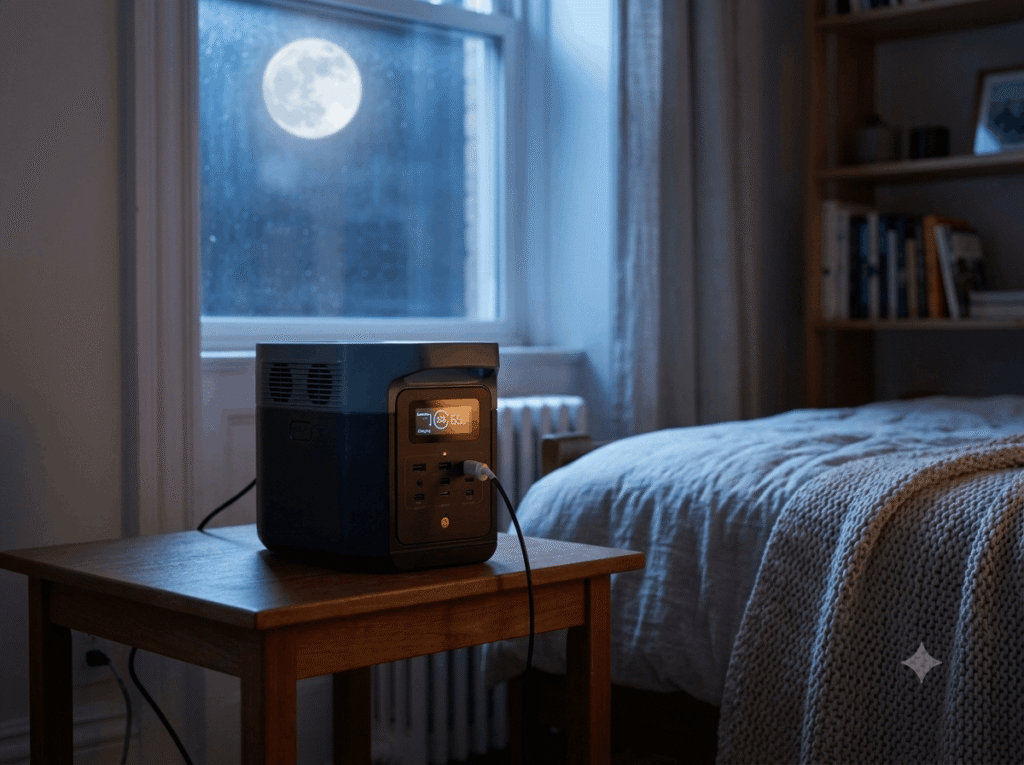
If you're with Octopus Go, you get a cheap overnight rate around 8.5p/kWh between 00:30 and 05:30. Compare that to the daytime peak rate, which sits around 30p/kWh. That's a massive gap.
Economy 7 works on a similar idea, giving you a cheaper night rate too, though exact pricing depends on your supplier.
So here's the play:
Charge your generator overnight on the cheap rate
Use that stored power during the day, when grid electricity is expensive
Add solar charging on top whenever there's sun, and you're stretching that saving even further
You're basically buying electricity cheap and using it when it would've cost you three times as much. No rooftop install, no fuss, just smart timing. Is solar financially worth it in 2026?
Read our honest breakdown → Is Solar Still Worth It in 2026 Without the Tax Credit?
Let's clear up some confusion here, because a lot of people ask about this.
The Smart Export Guarantee pays homeowners for extra solar electricity they send back to the grid. Sounds like something renters could tap into too, right? Unfortunately, no. Here's why.
SEG requires an MCS-certified renewable installation, a proper export meter, and a formal grid connection application through your network operator. A portable power station simply doesn't qualify. It's not a fixed installation, and as a renter, you're not in a position to register one on the property anyway.
So what's the actual smart move here?
Self-consumption. Instead of trying to sell power back to the grid (which isn't an option for you), just use every bit of power your generator makes or stores, directly. Charge overnight, run your devices off it during the day, and skip the grid pricing entirely during those hours.
Honestly, for most renters, self-consumption ends up being the smarter savings play anyway. No paperwork, no waiting on approvals, no meter installs. Just straightforward savings you control yourself.
In most cases, yes. Standard tenant or renters insurance policies in both the UK and US typically cover portable electronics under general contents coverage, which includes items like power stations.
That said, always double-check a few specific things with your own policy:
Is there a per-item value cap? Some policies limit payouts for single expensive items unless separately listed.
Does it cover accidental damage, or only theft and fire?
Is it covered while it's outside your apartment too, like on a balcony or during travel?
A quick call or email to your insurance provider clears this up in minutes, and it's worth doing before you rely on that coverage.
Alright, decision time. Let's make this simple.
Instead of scrolling back through everything, use this quick guide. Match your budget and your space, and you've got your answer.

If you're still not sure, just ask yourself one question: how much space do you actually have, and how much can you comfortably spend? The answer usually points straight to one row on this table.
If you want one answer and nothing else, here it is:
EcoFlow DELTA 3.It's not the cheapest option on this list, and it's not trying to be. What it gets right is the balance. Fast charging, compact enough for most apartments, room to expand capacity later if your needs grow, and enough output to actually run real appliances, not just your phone and a lamp.
For most renters trying to cover a genuine range of needs, from working from home to backup power during outages, this is the one that just makes sense.
Before you hit that buy button, run through this quick list. Takes two minutes, saves you a headache later.
Check Amazon for the latest price and active deals — prices shift often, don't buy based on an old number you saw somewhere else
Verify the UK plug adapter is included in the UK listing — some import listings ship with US plugs only
Check your building's balcony rules before ordering solar panels — a quick look at your lease or a message to your landlord saves confusion later
Read the return policy — most Amazon listings give you a 30-day window, know it before you open the box
Run your numbers first → Free Solar ROI Calculator before purchasing
Disclaimer: This post contains affiliate links. If you make a purchase through these links, I may earn a small commission at no extra cost to you. I only recommend products I truly believe in.